
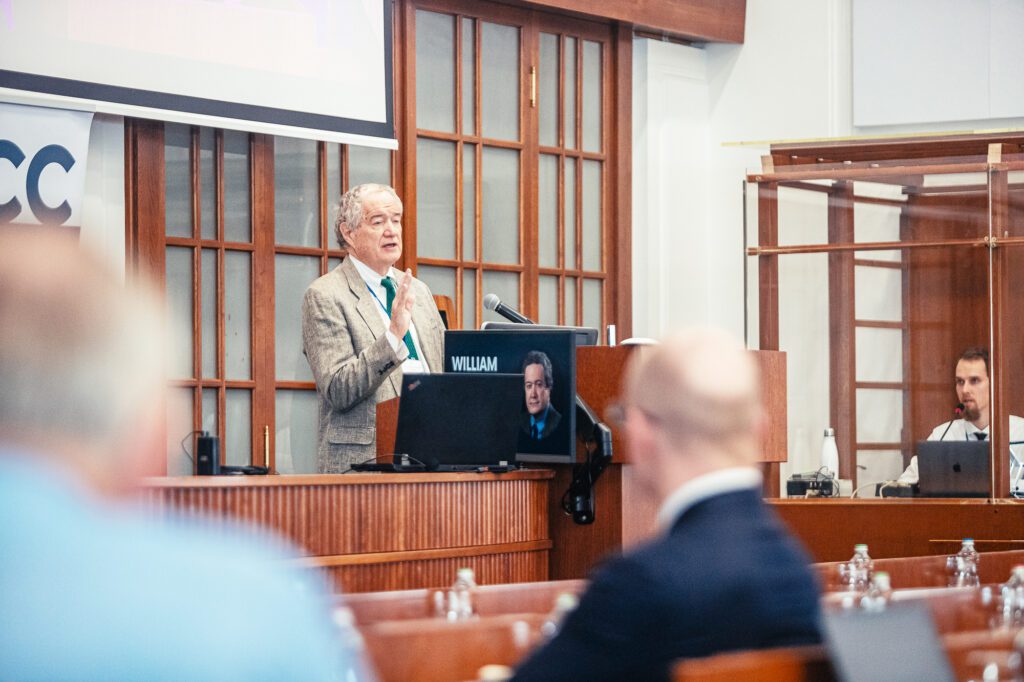
“In communism, people were just something to be used to get to the communist utopia. Then I saw that the abortion is just another way in which you use people,” says Professor Saunders.
Professor William L. Saunders is an American pro-life human rights lawyer and Chair Emeritus of the Religious Liberties Practice Group of the Federalist Society – an organization of which five of the current nine members of the US Supreme Court are or were members of.
We spoke about how he became pro-life, what was the role of John Paul II in it and what does communism have in common with abortions. But most importantly, we talked about how, after fifty years, it was possible for the US Supreme Court to overrule the Roe v. Wade decision, decision that legalized abortions in whole of USA.
The interview was made possible by William L. Saunders’s participation in the Conservative Law Conference and the Conservative Summit which took place on 7th and 8th November 2025 in Bratislava.
I don’t remember the decision at all. I was about 19 years old and I wasn’t a pro-life person back then so I wasn’t involved in the issue. I was used to the Supreme Court saying something was a right or wasn’t a right, and this just seemed like another example. Also, it wasn’t a big issue where I was from.
Before Roe v. Wade, there were different states that were considering expanding or restricting abortion. There were very strong pro-life states and just a few states that had legal abortion. It was not widespread in America before then.
Were you pro-choice back then or you just didn’t care about the issue?
I didn’t have a pro-choice position. I just didn’t pay much attention to it.
At what point in your life have you started to care about this issue?
During the 90s when I was reading John Paul II. I had become a human rights lawyer before that and so I was interested in human rights but I hadn’t thought of the implications of that for every issue under the sun.
And also there was an important American politician named Robert Casey, the governor of Pennsylvania. He was what they called a blue collar Democrat – he supported social legislation for working people, but he was also Catholic and pro-life.
I heard him speak about abortion at Catholic University in America and he opened my eyes like nobody ever.
How that happened?
I had absorbed the general view that abortion was somehow good for women, somehow it was inevitable what the Supreme Court did in Roe v. Wade because American states were already becoming having pro abortion laws.
And I learned that was all false. In American history, the states had become less in favor of abortion the more time that passed. And the more they learned about human development, the more state laws restricted or eliminated abortion.
I just realized all these assumptions and things I had picked up through my schooling were wrong. That made me start thinking about the humanity of the unborn and how that fit into the whole idea of human rights.
Was it rather intellectual process or something emotional?
The first part of it was very much intellectual, like what Robert Casey helped me to understand about legal history in America and opening my mind to think more deeply about it.
But there were other things that were going on in my life at the same time. It was around year 1996. There was a Catholic Bishop who asked me to help in Sudan. His people were being killed, but some of them were being taken as slaves by the government that was dedicated to radical Islamic ideology.
They were totally forgotten people. Nobody cared about them, nobody cared about Sudan. It is a dusty place in the middle of nowhere. And yet, when you connect with the people, you realize that’s a person just like you’re a person and the same thing could have happened to you.
The difference was I was born in America and these little kids that were being enslaved were born in Sudan.
Was this experience from Sudan connected to you becoming pro-life?
These are all mutually reinforcing things. I was doing human rights, and if you’re doing human rights, you start thinking about the rights of human beings. The Sudan work helped me realize the importance of each little human being.
In 1994, the UN had a big conference in Cairo about population control and that they tried to make abortion a human right. They failed because of the Vatican and some Latin American countries and some Islamic countries. Even when I was not strong a strong pro-life person, I knew there was no right to abortion in any of international laws. So that also opened my eyes to an agenda that was being pushed by left wing elites.
And then I think in 1996, Governor Casey wasn’t allowed to speak at the Democratic National Convention. This is extraordinary because it was the 5th largest state in the union and he was its governor.
It was because he was pro life?
Yes, solely because of that. Remember, this was the same Clinton administration that was pushing abortion at that international conference in Cairo. I was a Democrat at the time but I found that the Democratic Party is the engine for trying to deny dignity, worth and rights of every human person, including the unborn, in law and in policy, and to promote abortion.
Were you Catholic at that time?
No, I was a Methodist but I became a Catholic shortly after this period. In America, if you’re pro-life, they’ll say, well, you’re just a Catholic, so you don’t really believe it; you just do what the Church tells you. But I became pro-life before I became Catholic, so that’s important for me. However, the religious point of view should be consistent with the objective one, and it is.
So since 1973 there had been the right to abortion, but there’s been opposition from the beginning – the March for life. But at the beginning the only opposition came from the Catholic Church.
I remember reading John Paul II in the newspaper say how it was important that people treat each other with dignity and not use one another as objects to achieve something. He was talking about sexuality but it stuck in my mind because I was aware of the atrocities committed by the Communists. And I was very much aware of Vladimir Lenin’s view that what you should do is use people to achieve the ends.
People were just something to be used to get to this communist utopia. That resulted in 100 million people being killed. When I had thought about communism, I hadn’t thought about abortion. But then I saw that the abortion is just another way in which you use people.
Why did you even care about communism?
When I was in university, my studies were in political theory and history, and I read The Gulag Archipelago from Aleksandr Solzhenitsyn. Anybody reading this interview should read that book because it is the great record of what happens under the Communists. People ask me, what’s the single most important book you ever read? That’s the most important book.
It’s a detailed documentation of how the Communist Party came to power, destroyed everybody who opposed them, then destroyed everybody within the party until the end. You can sit in the classroom and talk about everybody being equal in this communist Garden of Eden. What you’re going to have is the gulag.
It helped me to understand the importance of good democratic institutions as we have in the US.
During the 90s, you joined the Federalist Society. How that happened?
I was working with my friend Robert George, who I went to law school with and who actually introduced me to Governor Casey.
We were working in an agency in the US government called the US Commission on Civil Rights and we were approached to help start the Religious Liberties Practice Group in the Federalist Society.
What was the main goal of the Society?
It was intended to be a response and a counter to what’s called critical legal studies – which is just Marxist legal studies. That movement had started in the late 70s.
The critical legal studies said that every law, every decision is just about power. Therefore everything must be resisted and overturned. For example, if I was a judge, what I should do is realize whatever the law says is just an instrument of oppression and I should rule for what I think and what I understand will make a more just world.
The Federalist Society says: Wrong. What a judge should do – and the only thing a judge should do – is to say what the law that applies to this dispute is and then apply it.
If there is a political issue like discrimination or whatever deeper society issues, that should be dealt with through the Legislature.
Would you say that the Roe v. Wade was an example of judicial activism?
Absolutely. The greatest example of it in U.S. history. What it did was it made abortion a national right but an abortion is killing an innocent person. So it’s saying that there’s a national right in America to kill innocent people.
If you read Roe v. Wade, there’s very little legal analysis. There’s all this mumbo jumbo about what they think about psychology or medicine or whatever but that’s not the issue. The issue is what does the Constitution say about abortion?
There is no abortion in the Constitution – there are no words for it. When the Constitution was amended in 1866, nobody on God’s green earth thought the word liberty in the 14th Amendment was a synonym for abortion. What it did say and what people understood it to mean and what it meant was that freed slaves, because this was after our Civil War, were equal citizens. It had nothing to do with abortion.
But because the majority of justices in 1973 thought there should be a right to abortion, they said the Constitution creates it. That’s judicial activism.
In 2022, in Dobbs v. Jackson Women’s Health Organization ruling the Supreme Court overruled Roe v. Wade. What lead to it?
The Federalist Society’s view is that the judge’s job is to apply the law not to say what he thinks the law should be or to say the law is something different than is written down but what he thinks that it should be. And that’s called originalism. It says that if I’m going to apply the law, I want to know what the original meaning of the text was.
With that theory, the Federalist Society, which doesn’t take positions, grew and grew and expanded and had lots of lawyers and judges who agreed that the judges shouldn’t be activists.
Eventually, the political pro-life movement told Republicans that we will not vote for you unless you put originalist justices who would apply the Constitution on the Supreme Court. When there was a majority of justices who would do that, they overturned Roe v. Wade.
These nominations were made during Trump’s administration. How come this didn’t happen earlier during earlier Republican presidents?
The third most important American case on abortion besides Roe and Dobbs is a case called Planned Parenthood v. Casey in 1992. The Supreme Court was asked in the case whether they would overturn Roe, and the Supreme Court upheld it by a very close vote of five votes to four.
In the interim years after Roe, under Reagan and under George H.W. Bush, the Republicans had appointed three justices to the Supreme Court, all of whom were supposed to be conservative. It was assumed that they would realize that Roe was not based on the Constitution and they would overturn it. But in Planned Parenthood v. Casey, none of those three joined the four who were ready to overturn Roe.
Why?
Because they weren’t originalists.
Why they were nominated then?
Because they were conservatives. It was assumed that if you were appointed by Republican president and you were known to be a conservative judge, you wouldn’t uphold Roe v. Wade.
From that moment on we were all focused on the importance of the jurisprudential views of the judge, we have to have originalists, not somebody who’s just a conservative. And so when it came around to Trump 20 years later, he put originalists on the Supreme Court.
Some people say that it was the Trump’s biggest achievement. Would you agree with that?
One of the biggest. First of all, it’s saved a tremendous number of lives. People are not being killed where they could be killed before. It saves lives; it also teaches the American people that the abortion is the negation of the idea of human rights.
If some people can kill other people, there are no rights that attach to you because you’re a human being. You can even be arbitrarily killed. It was a terrible lesson to teach the American people.
I think it also teaches people in Europe. When I was coming to Europe over the years, there was a lot of coverage in Europe and I’d hear people talking about it. The Supreme Court has huge impact and people see it as a great “organ of human rights”.
One might say that in Europe it had the opposite effect – in France they put the right to abortion to their constitution and the progressive politicians even tried to include the right to abortion into the European Charter of the Human Rights.
I don’t agree that it had the opposite effect. I do agree that the pro abortion people were finally forced out in the open. In other words, I don’t think France really is more pro abortion now than it was before.
I think what it did was it told countries like Slovakia or Poland that this “great US Supreme Court” is now telling you there is no right to abortion as a human right.
Do you think we in Europe can get inspired by what happened in the US and use it to strengthen the protection of life?
Go back to this population conference in Cairo in 1994: the elites of the world were trying to force everybody in the world to have a right to abortion. Now, at least you could say to them that there is no right to abortion, we acknowledge that in the United States. So it’s not accepted international right.
And if you don’t accept it culturally in Slovakia, you can’t be forced to accept it.
What piece of advice would you give to Slovak pro-life politicians, lawyers or people in general?
One of the biggest problems in the world is that ordinary, good, decent people don’t realize that a lot of national and international organizations are run by people who pursue an agenda without being elected to pursue that agenda.
I used to work at the UN where the biggest problem was all these international bureaucrats who lived very well on all the money that all the countries paid. They lived at fancy hotels, dined out at fancy places and all agreed abortion was a good thing. So they were trying to push it through UN Development assistance. Ordinary people don’t realize that kind of stuff is going on.
Don’t just assume the government is going to do the right thing. You have to insist that your elected officials promise to do the right thing, and if they don’t, you vote against them next time.
Donald Trump knew that he would not get the pro-life votes unless he promised to put originalists on the Supreme Court. And so he did it. That’s a good politician – he does what he promised to do. But he only did it because the pro-life people are organized and have enough political power that their votes matter.
We had Roe v Wade in America for fifty years. The people said it is never going to be overturned. And it was overturned. So you just have to keep doing the right thing and never lose hope. Maybe we fail, but people learn from us and then ten years later, they get it done.
The people who are in power depend on you losing your determination. You defeat them if you don’t give up.